Two matches, one swing factor: FTC's 6v5.

Ferencváros and Pro Recco met twice this season. Pro Recco won the first, FTC won the second. Same opponent, same goalkeeper, almost the same defensive shape. The deciding difference was how FTC's power-play performed.

The WPI analysis process

FTC-Telekom and Pro Recco played twice within seven weeks of each other in the Champions League quarter-final group stage. The scorelines flipped: Pro Recco won the first 13–9, FTC won the rematch 16–14, and the headline number pointed at a significant tactical shift from both teams.

In the match FTC lost, their 6v5 power-play produced just 4 goals. In the match they won, the same phase of play produced 9, more than double against the same opposing defence and the same goalkeeper. This case study traces that swing from the data, into the shot maps, and finally onto video. Three concrete tactical changes explain this difference in outcome.

1
Identify the period & game state

Compare both fixtures by period and by event type to locate where the outcome was decided.

2
Quantify the 6v5 gap

Goal-rate-by-event data confirms a significant difference in FTC's power-play conversion between the two games.

3
Map the shots

Pitch attack-location maps show where 6v5 shots originated in each match and how outcomes differed by zone.

4
Target video review

Use the data to identify exactly which periods and zones to review on film.

5
Confirm on film

Three tactical changes between the two games are visible on video, explaining the statistical shift.

Reading the box score for both games side by side

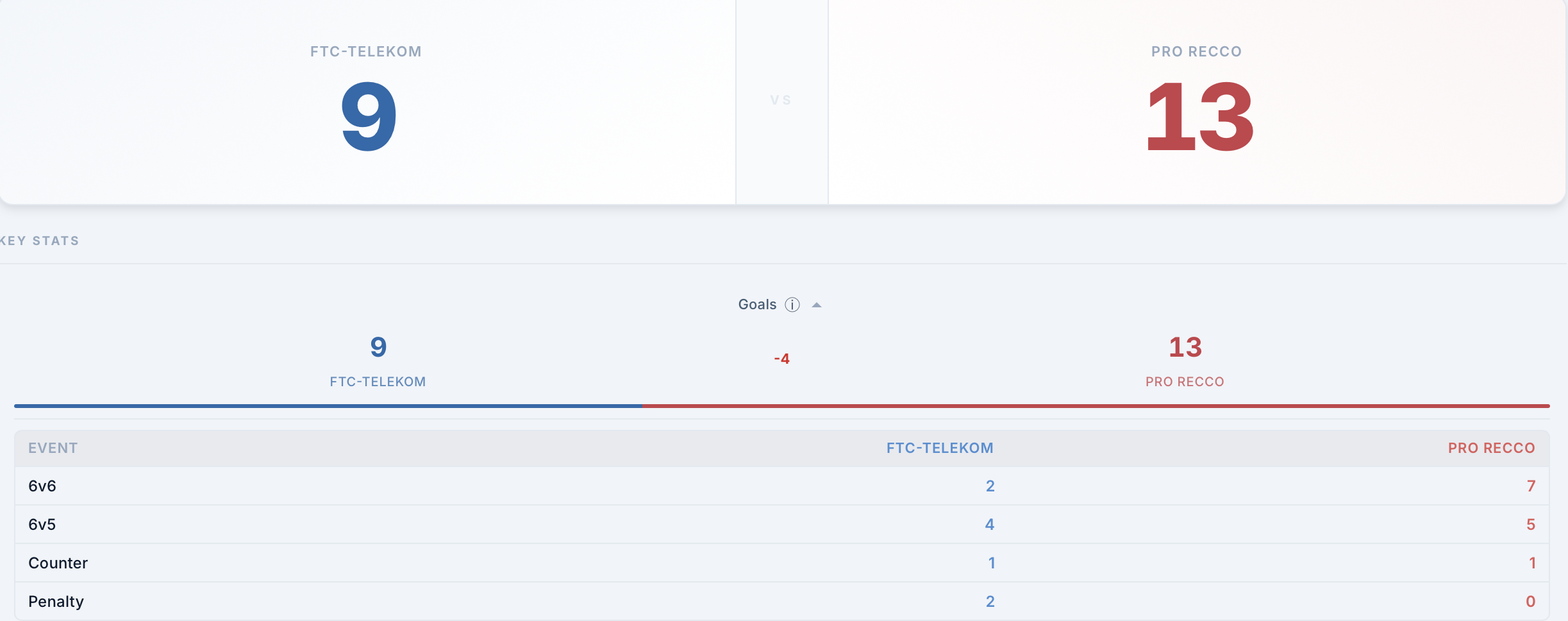
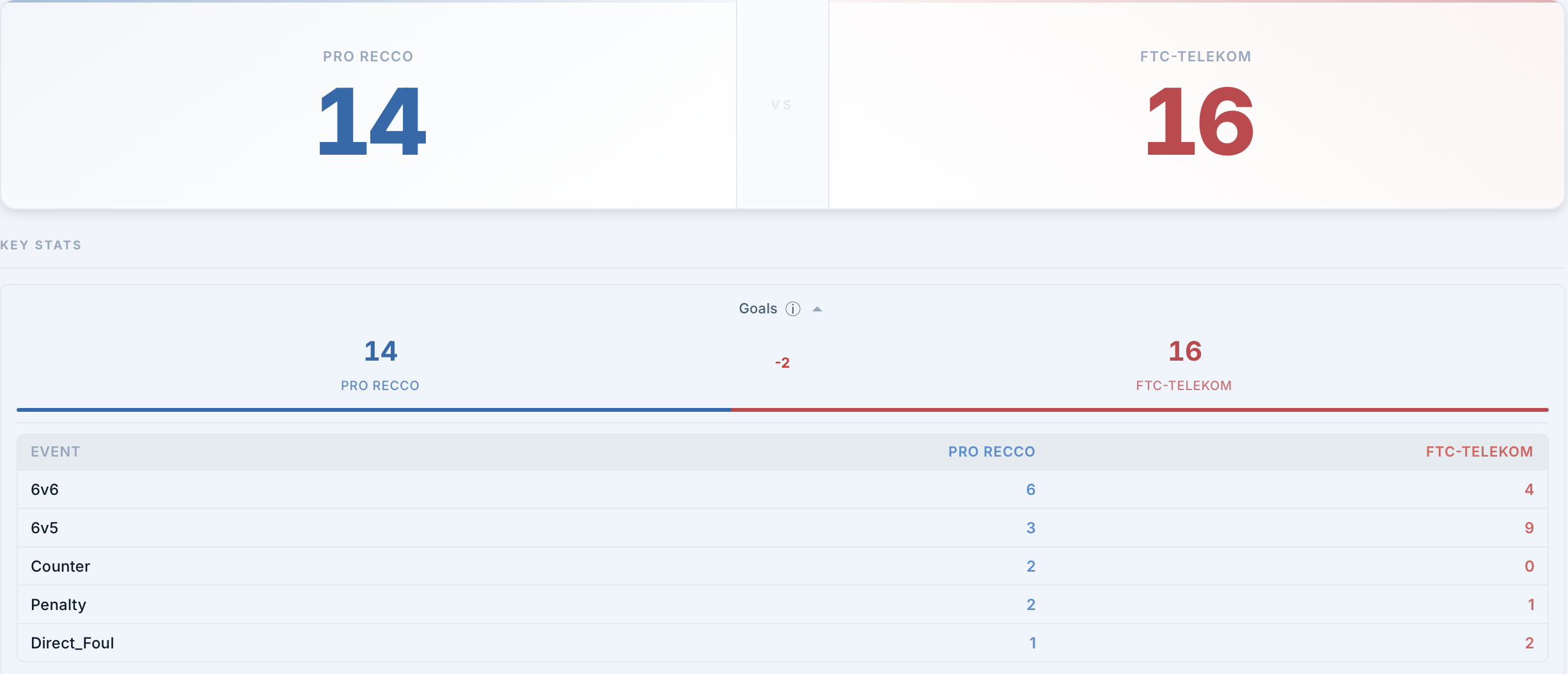
Both dashboards below are pulled directly from the analysis platform. The event breakdown (6v6, 6v5, counter, penalty, direct fouls) is the first place to look when two results between the same teams diverge this sharply.

FTC's power-play undershoots

FTC's power-play undershoots

Shows
FTC drew 4 6v5 opportunities in the event table; their overall output was 9 goals to Pro Recco's 13.
Conclusion
The scoreline gap (−4) is close to the 6v5 shortfall on its own, a strong first signal.
The same fixture, a different power-play

The same fixture, a different power-play

Shows
FTC's 6v5 column shows 9 goals, the standout number on either scoresheet.
Conclusion
A +5 swing in 6v5 goals, alone, accounts for nearly the entire +6 swing in FTC's final score across the two fixtures.
âš‘ Key insight

Two matches, same opponent, +5 goals difference in 6v5 output alone, almost exactly matching the swing in the final result. Before looking at anything else, this is the phase of the game the analysis needed to explain.

Where this data comes from

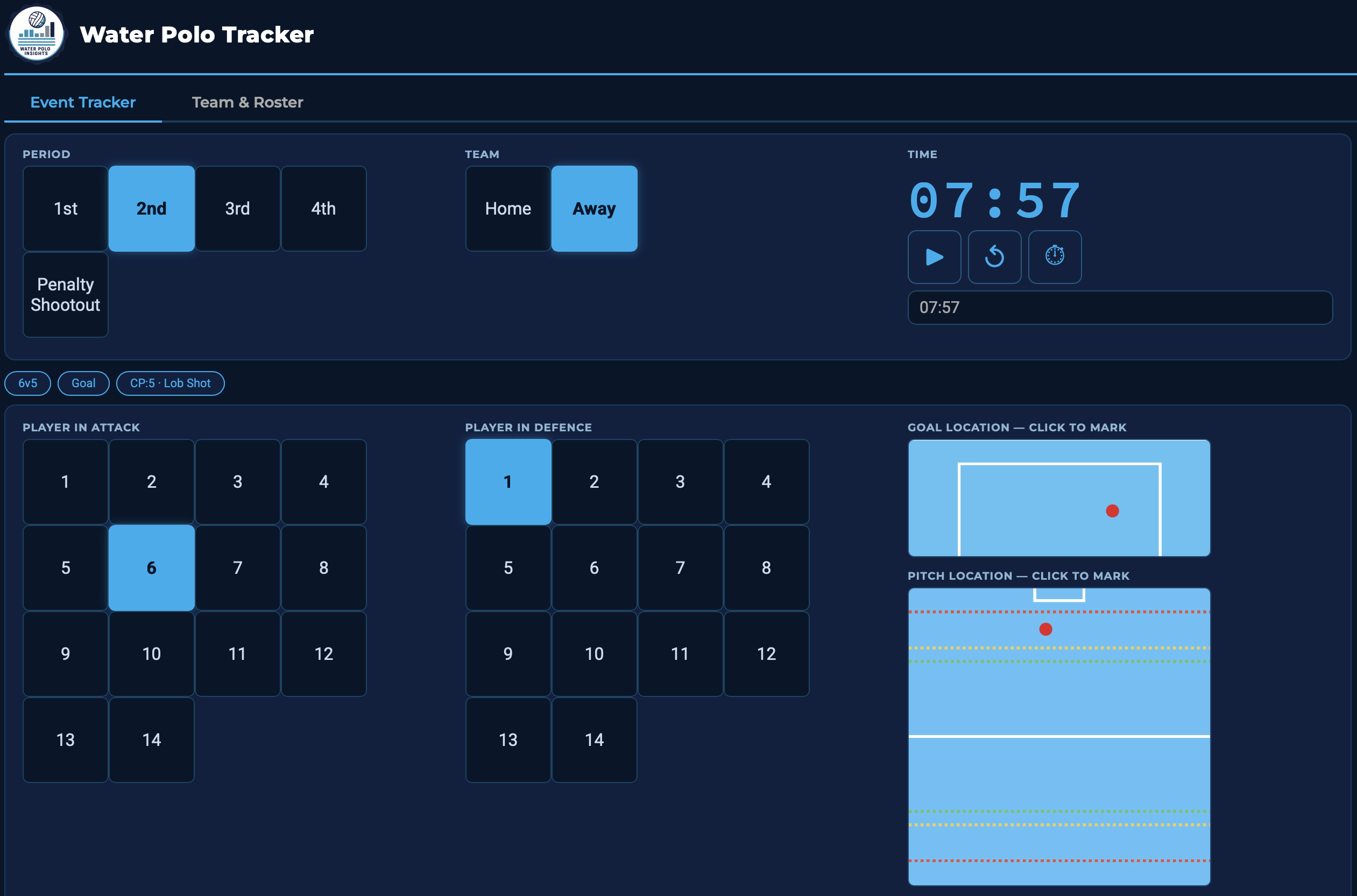
The dashboards above are pulled from Water Polo Insights' analysis platform. But not every match already has this kind of data sitting online. For competitions and fixtures where existing statistics are scarce, WPI collects it manually using its own Data Input Dashboard, a purpose-built tracker for logging every attack, shot, and exclusion straight from match footage.

The Data Input Dashboard, mid-event

The Data Input Dashboard, mid-event

When in the game did the power-play work, and when did it not?

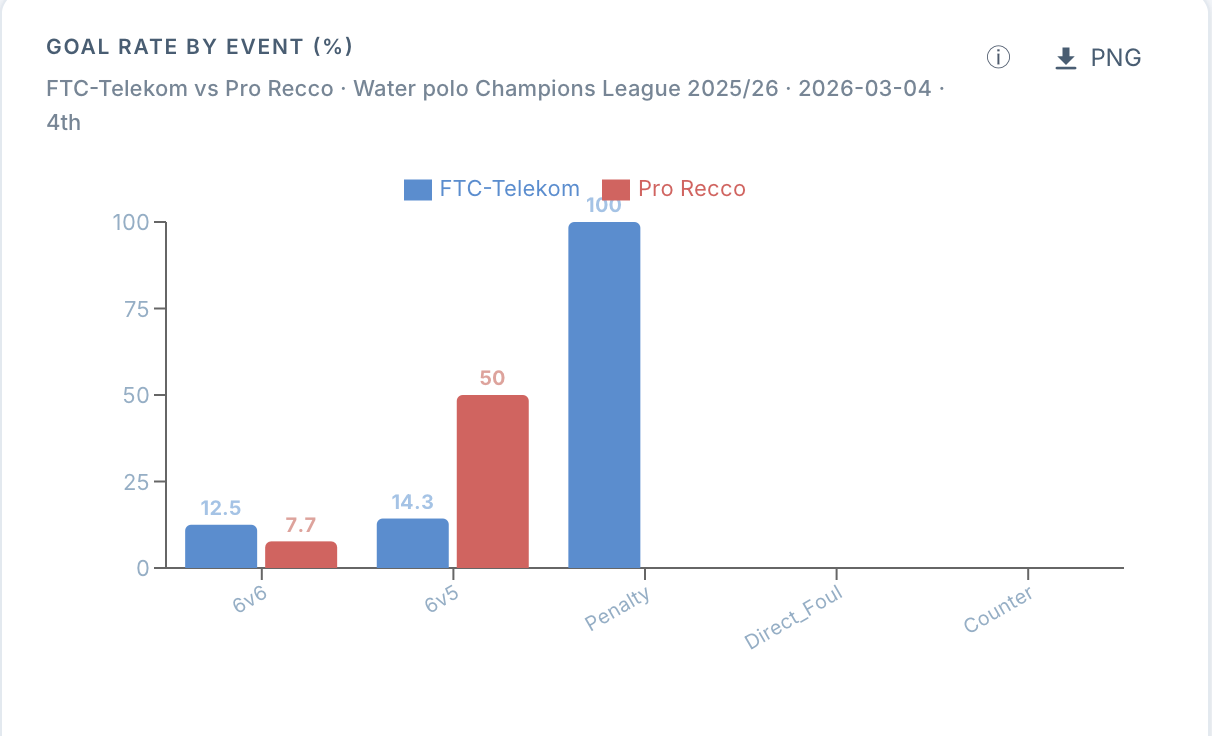
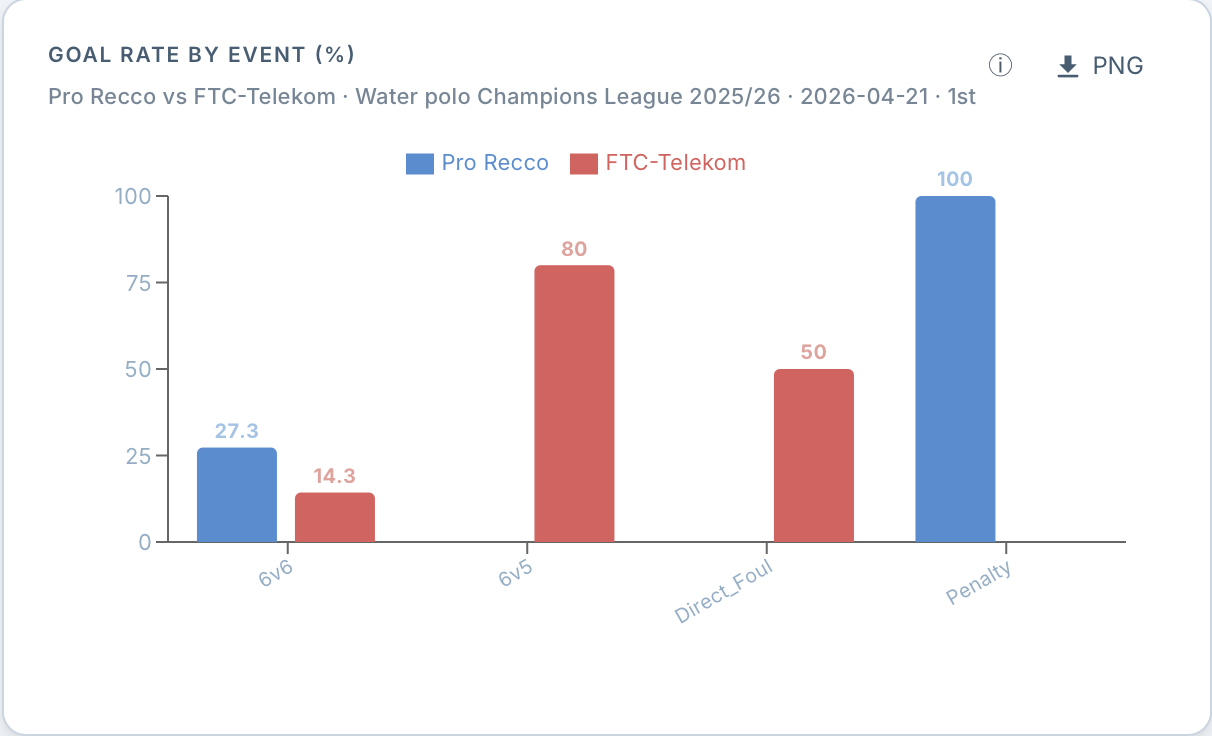
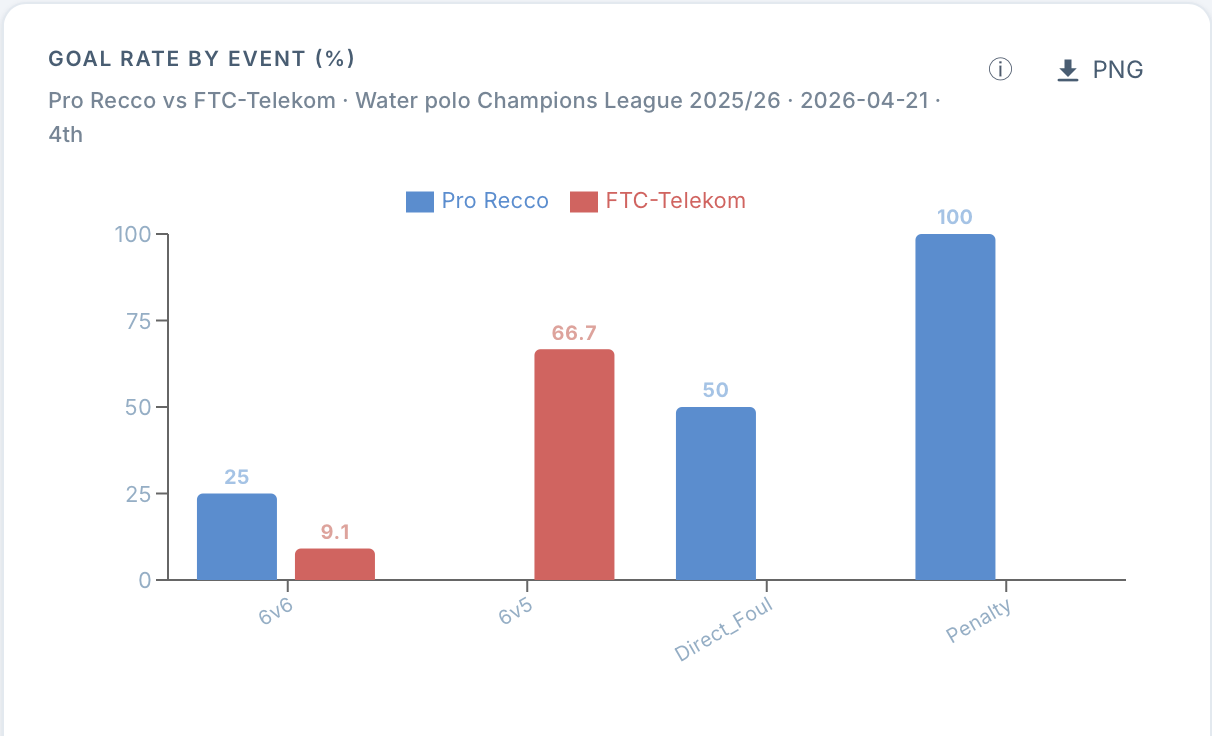
Goal-rate-by-event charts for the 1st and 4th periods of both matches show precisely when in each game FTC's 6v5 attack worked and when it didn't.

A cold start: 0% in the 1st

A cold start: 0% in the 1st

Shows
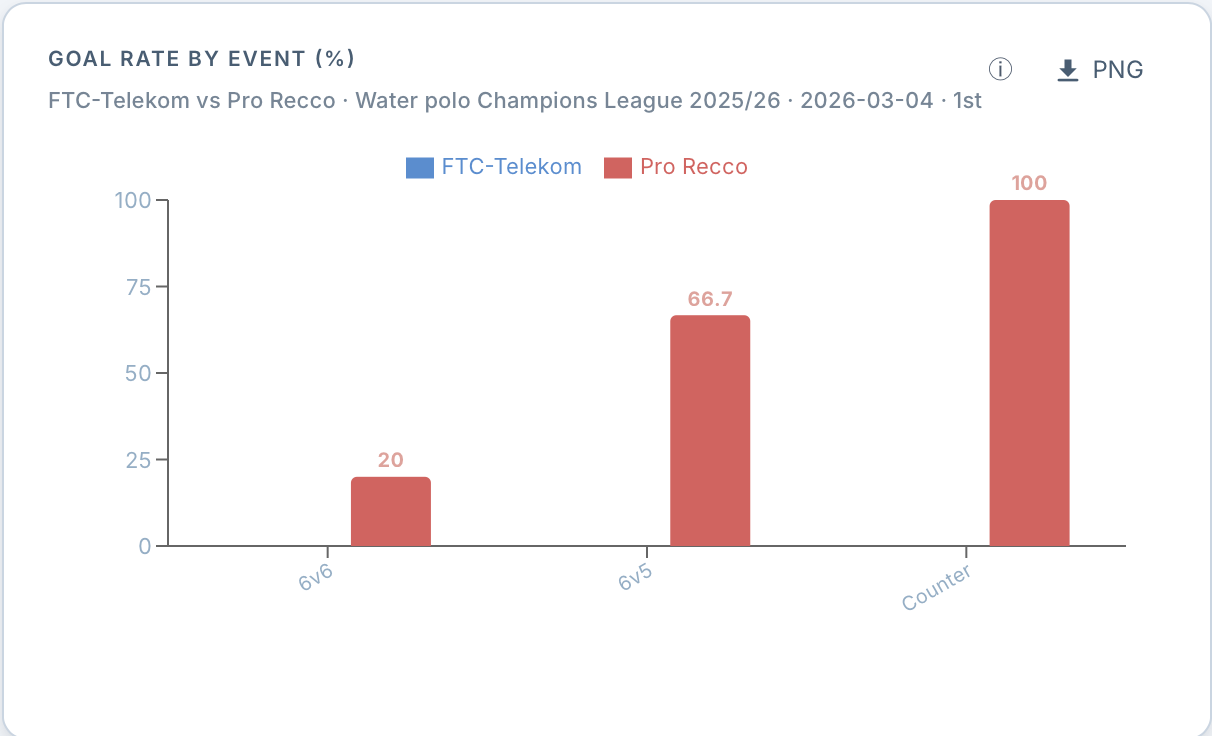
In the 1st period, FTC failed to convert a single 6v5 opportunity, a 0% conversion rate, while Pro Recco's own 6v5 attack posted 66.7% in the same period, their best period for 6v5 in the match.
Conclusion
The 1st period was already a red flag: FTC's 6v5 attack was shut out while Pro Recco's converted at a high rate in the same window.
Still cold: 14.3% in the 4th

Still cold: 14.3% in the 4th

Shows
By the 4th period, FTC's 6v5 conversion rate had improved only to 14.3%, still a low percentage for 6v5 conversion.
Conclusion
The 1st and 4th periods were FTC's two worst 6v5 conversion rates in the match, making them the priority for video review.
A strong opening: 80% in the 1st

A strong opening: 80% in the 1st

Shows
In the rematch, FTC opened with an 80% 6v5 conversion rate in the 1st period, higher again than either period of the first match.
Conclusion
The question becomes: did this match also see a 4th-period drop-off, and if not, what changed?
No collapse: 66.7% held in the 4th

No collapse: 66.7% held in the 4th

Shows
In the 4th period of the rematch, FTC's 6v5 conversion rate was 66.7%, dramatically higher than the 14.3% seen in the equivalent period of the first match.
Conclusion
The 1st and 4th periods of both matches now require closer analysis on video.

Match Lost · 04/03/2026

1st period 6v5 conversion rate0%
4th period 6v5 conversion rate14.3%
Match total 6v5 goals4

Match Won · 21/04/2026

1st period 6v5 conversion rate80%
4th period 6v5 conversion rate66.7%
Match total 6v5 goals9

Same goalkeeper, two very different shot pictures

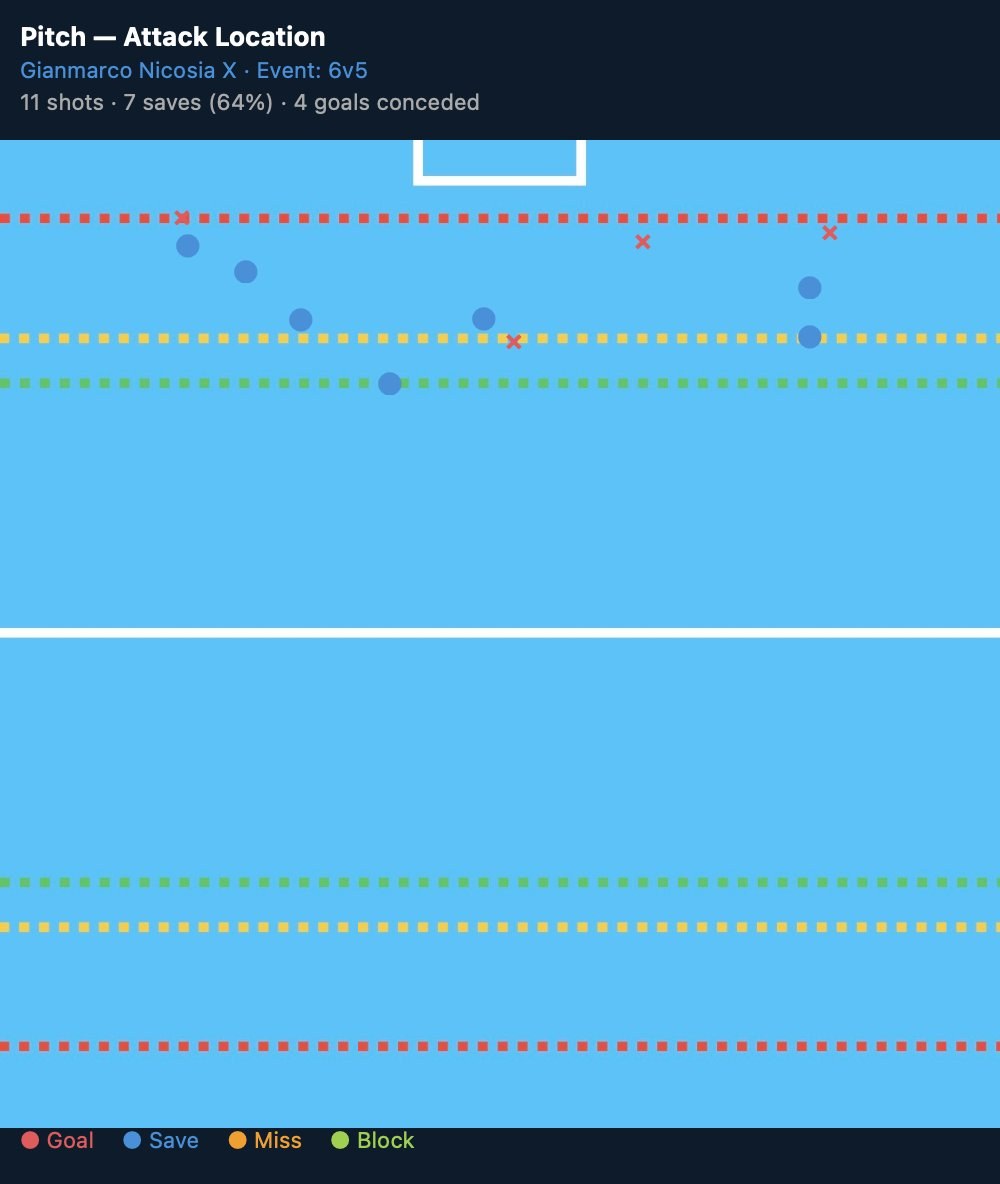
With the priority periods identified, the next step was to map every FTC 6v5 shot against Pro Recco's goalkeeper, Gianmarco Nicosia, in both matches, outcome and origin together. The pitch diagrams below come directly from the analysis platform.

11 shots, 7 saves, 4 goals: heavily neutralised

11 shots, 7 saves, 4 goals: heavily neutralised

Shows
11 FTC 6v5 attempts against Nicosia. 7 were saved (64% save rate for Nicosia), with shots spread mostly evenly across the goal.
Conclusion
This shot distribution is the "before" picture: broad, low-conversion, and short on a clear target zone.
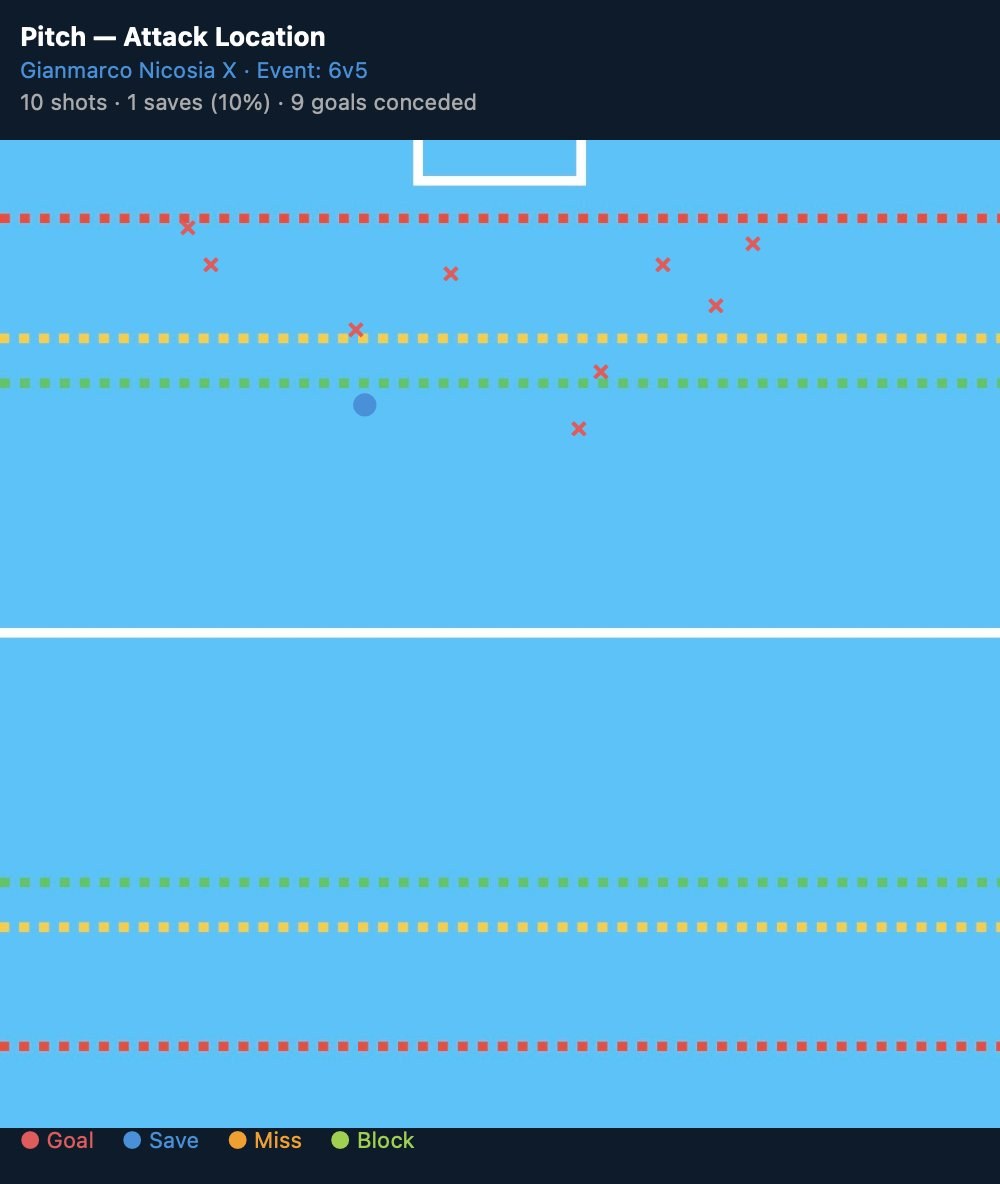
10 shots, 1 save, 9 goals: a target found

10 shots, 1 save, 9 goals: a target found

Shows
10 FTC 6v5 attempts against Nicosia in the rematch. Only 1 was saved (10% save rate for Nicosia), with a noticeable cluster around positions 1 and 2, but scoring improved in all positions.
Conclusion
This flags positions 1 and 2 in the match FTC won as a further area to focus analysis.
âš‘ Why this matters for video review

The shift from a broad, low-conversion shot map to a concentrated, high-conversion shot map, against the same goalkeeper, is exactly the kind of signal that data alone can flag but not fully explain. These shot maps give a further indication of where to look during analysis, specifying not just the phase of play but also the area of the pitch where a change appears to have happened. The next section shows what video review found in that zone.

From "where" to "why": three tactical changes on film

With the priority periods (1st & 4th) and zones (positions 1 and 2) identified from the data, video review of both matches' 6v5 sequences in those windows revealed three concrete, related changes in how FTC attacked the power-play.

01

Shot selection from position 3: the same opportunity, missed then taken

In their lost match, FTC shot often from position 3 (centre) without consistently targeting Nicosia's weak area (around his head and shoulders) with donut shots: a 0% 1st-period and 14.3% 4th-period conversion rate. In the rematch, the same position 3 chances were converted via that shot, with no material change in Pro Recco's defence. The difference was FTC's better execution of a recognised weakness.

02

A tactical trigger: a passive position-4 blocker gave FTC the space for a more precise shot

In the match FTC won, Pro Recco's position-4 defender gave the shooter more time and space for a clean release. In the match they lost, the same defender committed hard, forcing a rushed miss. The difference was in Pro Recco's defending, not FTC's own decision-making.

03

Movement to the first post: creating space in the position 1-2 area to score

In the match they won, FTC added consistent movement toward the first post, opening space around positions 1-2 that Pro Recco's defence couldn't close down and didn't adapt well to. This was largely absent in the match they lost.

"Fewer blockers, more space, a cleaner release, and a higher conversion rate. The data flagged where to look, and the video confirmed the pressure at position 3 was the problem."

Analyst's note, video review

Finding 01 · Reference clips

Two clips from the same 6v5 situation (position 3), one from each match. Watch both back to back to see what changed between the games.

Position 3: a donut shot exploits Nicosia's weakness

The FTC shooter at position 3 takes a donut shot to Nicosia's known weak area. It's the precision of the shot, not a defensive lapse from Pro Recco, that beats the goalkeeper here.

Position 3: the same idea, but off target

FTC again has the ball at position 3 in a 6v5. This time the shooter is less accurate with his shot. Ultimately the idea is the same (he strikes the crossbar above Nicosia's head), but he catches and shoots immediately. The response of Pro Recco in defence has no substantive difference.

Finding 02 · Reference clips

Two clips from the same 6v5 situation (position 4), one from each match. Watch both back to back to see what changed between the games.

Blocker commits hard: shooter rushed, chance lost

The position-4 blocker commits hard, reaching the shooter aggressively. FTC play a full-attack possession with short passes across the front, but the pressure at position 4 means the shooter never gets the space for a clean release. The possession ends with a shot which is easily saved.

Blocker gives ground: shooter finds the space, goal

The Pro Recco blocker at position 4 doesn't press as hard this time, giving the shooter an extra half-step of space. That room is exactly what's needed: the release is clean and well-placed, and Nicosia can't adjust in time. Goal.

Finding 03 · Reference clips

Two clips from the match won showing the first-post movement in action.

First-post run: a gap in coverage, goal

FTC's attacker drives hard toward the first post from position 4. The Pro Recco defenders at x2 and x1 don't notice the change of attacking formation. When the ball goes to position 1 the player attacks, without the player at position 2 moving back in to help with the post. The centre defender tries to get across but can't do so quickly enough. This results in a goal.

Di Fulvio loses position: attacker moves in from position 1, goal

Di Fulvio, tasked with defending position 1, loses his defensive position during the sequence, after a faked shot from position 3. The FTC attacker at position 1 reads this immediately and on receiving the ball moves in toward the first post. The late movement, exploiting Fulvio's positional error, creates a shooting opportunity that didn't exist a second earlier. Nicosia cannot adjust; the shot from position 1 goes in.

The data pointed to where. The video explained why.

Across both matches, the swing in FTC's 6v5 came down to a small number of repeatable details: sharper shot selection from position 3 into Nicosia's known weak area, a more passive position-4 blocker giving the shooter time and space, and first-post movement that stretched Pro Recco's defence past its breaking point. None of these are single-moment fixes, they're patterns that showed up on the data first and were confirmed on film second. Further video analysis, and training built specifically around these areas, could be considered as the next step for a team to take.